


 As a consultant and speaker with over three decades of experience, I often tell people that I’ve made all the mistakes there are to make in sponsorship, so they don’t have to. From terrible search-and-replace proposals with gold-silver-bronze levels to “measuring” sponsorship results in media equivalencies and “good corporate citizenship” values made up out of thin air, I’ve done it all, learned from it, and figured out a much better way.
But there’s one story that really tops them all. It has danger, drama, and bad decisions. With the benefit of many years, I can see the humour in the situation. At the time, I was wondering if my career – and maybe life – was going to end that day.
So, here it is: The blimp story. It’s a chance for you to have a laugh at my expense, because wow. Just wow. Read on…
Although I’d done sponsorship as part of previous jobs, there I was, age 22 and in my very first full-time sponsorship job. It was with a startup agency. Three partners and I was the first employee. I was a crazy hybrid of receptionist and event manager, shifting fully into event manager as more people were hired. This involved spending many weekends travelling around America to professional sports venues, running live events and hospitality for sponsors. The pay was low, and the hours were crazy, but it was so much fun, and I loved every minute of it… almost.
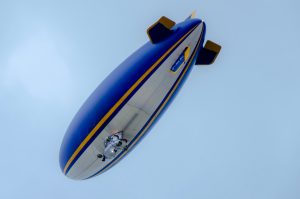
We’d been doing pre-game events with a bunch of NFL teams, on behalf of one of our sponsor clients. One of the big features of these events was a 10+ metre long blimp, emblazoned with the sponsor logo. It was full of helium, and usually did a pretty good job of staking out our territory and attracting fans.
A colleague and I spent one particularly miserable day in Indianapolis, throwing a pre-game party outside the stadium in a sleet storm. The blimp was flying high. There were piles of merch and munchies at the ready. But hardly anyone showed up. In that weather, you could hardly blame them.
When it was all over, I did what I’d been doing for all the games. I deflated the blimp and packed it into a box to ship it directly to the next game, saving us from having to lug it back and forth on planes. So, there I was… packing a soaking wet blimp, with a soaking wet harness and tether rope, into a cardboard box, giving it a lot of extra tape so the box didn’t disintegrate on the way.
Fast forward to the next weekend in Houston. The party was in a hotel parking lot on the outskirts of the Astrodome. The client’s local reps were there as we were setting up. It was extremely windy, and I told them that it was a bad idea to fly the blimp that day. They overruled me. I was young and didn’t want to get in trouble, so I did what they told me to. Big mistake.
I pulled the blimp out of the box, and it was still wet. So was the harness and tether rope. Soaking, dripping wet. I didn’t think too much about that, concentrating instead on where I could put this thing up that people could see, but wouldn’t cause a danger if it crashed in the swirling winds.
I settled on tethering it quite short, tied to the bumper of our rental van. There was a high-power line not far away, but I did the calculations and added 10%, which was supposed to be the amount the rope could stretch if it was wet.
Now, when I say this was a high power line, it was the kind that had like a dozen or more lines, held up by cross beams that were arranged in kind of a Christmas tree shape. It was huge, and actually hummed – loudly – when you stood near it. It was no joke. But there was basically nowhere else to put the blimp. The lot wasn’t that big, and the hotel took up most of it. I thought if the blimp was tied up short, it would be fine.
Pretty sure you can see where this is going.
The event itself went extremely well. There were lots of people partying away before the game, before eventually buggering off to their seats, as did the local reps. When we heard the roar of the crowd in the Astrodome, we knew it was time to load out.
As I was walking toward the blimp, thankful that nothing bad had happened, it started diving around wildly, before dive bombing directly into one of those high-power lines and wrapping itself around the line several times. The rope had clearly stretched way beyond the advice in the instructions, and now we had a disaster on our hands.
I was yelling, “Call the power company! Call the power company!” to anyone listening, and my colleague disappeared into the hotel to report the crazy catastrophe. Meanwhile, I ran over to the blimp, looked up, and realised that it had crashed into the upwind power line, and the wind was pushing that line dangerously close to the next line over. Like maybe 10-15 cm (4-6 inches) close. I studied physics in uni. I knew this was bad.
My initial thought was to move the van a tiny bit to stabilise the blimp and the line it was on, but the van was parked sideways to the line, so I didn’t think it would be feasible. The only other option I could think of at the time was to physically pull it away from the other power line.
I stood there, looking at the tether rope tied to the van, up at the dangerously close lines, and back down at the tether rope. Was it dry, I thought. Did all that wind dry it out, or was I about to die for my job? Spoiler alert: I didn’t die. The line had dried.
At that point, I grabbed the line and walked it backward a couple of steps, pulling it more-or-less out of the danger zone. There was another smaller rope attached to an emergency hatch on the blimp. It was basically a glued-on flap that could be released by pulling the small rope. Given that this smaller rope was also wrapped around the power line, it took quite a lot of pulling and yanking, but it finally came open and very slowly started losing helium.
Not long after that, Virgil showed up. Amazing that I can remember his name all these years later. Probably the trauma! He was one man from Houston Lighting & Power, driving a pickup truck with a little cherry picker mounted to the back. He took one look and said, “I thought this was a kid’s balloon.” He got on the radio and called for reinforcements.
Then, talking as if he was trying to disarm me, he said slowly, “Now, I want you to gently let go of that rope.” I did, at which point my heart finally started beating again. He pulled out a yellow, telescoping stick with a hook on the end and hooked it over the line, stabilising it.
My sense of relief was so enormous that I started to see the funny side – at least for a moment. I pulled out the video camera I’d used to document the event and started interviewing Virgil.
Me: Virgil, what would have happened if those two lines had touched (pointing the camera up to where the blimp was hanging)?
Virgil: First, there would be a fire as big as that hotel.
I gasped. He continued.
Virgil: You would have blacked out the Astrodome during a nationally televised game. 40 square miles of Houston would be in the dark. And you’re lucky it’s a Sunday, because you’d only do $2 million dollars an hour in computer damage.
By the time he finished, I was pretty much hyperventilating.
Not long after, his colleagues showed up. There were about a dozen blokes and seven bucket trucks, including a few really big ones. Once they got there, the blimp was cut down within about ten minutes. They were pretty amused with the situation, but NOT happy with me, as they’d been watching the game back at the depot.
My colleague and I waved as they drove away, equal parts stunned and relieved. It could have gone so badly, and somehow didn’t. There were a few drinks at the airport before our flight. How were we going to explain what happened to our bosses? Would I still have a job?
Honestly, I can’t remember how we told our bosses, and I somehow kept my job. I learned to trust my gut, take product specifications with a grain of salt, and never again did I let a client bully me into doing something risky.
With hindsight, I also realise how extremely lucky we were that the client had left. Even more, that no one from media had seen the crashed blimp with the client’s huge logo all over the sides, and that social media didn’t yet exist. Bullet dodged in about a dozen different ways.
I wish I still had the video, though.
If you’re interested in working with me, I can provide the following options. Just click through for more information, and drop me a line if you want to discuss.
© Kim Skildum-Reid. All rights reserved. To enquire about republishing or distribution, please see the blog and white paper reprints page.