


 Like most people, I’ve been working with AI across a lot of functions. I’m working out effective ways to use AI with sponsorship, and figuring out what doesn’t work… yet. With this blog, though, I’ve gone a different direction. I created a comprehensive prompt, and with a bit of trial and error, Claude gave me its (his?) take on the ten biggest questions that brand managers ask about sponsorship.
Are these, in fact, the biggest questions? I don’t know. Maybe?? I know I’ve heard all of these questions a lot, so I think they’re probably pretty close. Close enough that it’s worthwhile answering them, anyway.
So here we go… Claude’s questions and my answers. I’ve provided links to additional resources, where pertinent, and there are some more general resources at the end.
This is quite a big question, and the answer winds all the way back to before committing to a sponsorship, and goes right through to measurement.
Get rid of any leverage planning tools that include literal boxes to tick. This is going to stifle both creativity and results. You may have a big bank of leverage ideas (and if you don’t, we should talk), but every sponsorship is different, so those ideas may be vastly different from one sponsorship to another.
At this point, you will go ahead and negotiate, work with stakeholders to fine-tune the draft leverage plan and make it happen, and collaboratively measure against real, overall objectives.
The issue with this question is that it misses a huge piece of what makes best practice sponsorship so powerful.
If you look at the chart below, most sponsorship is both bought and sold based on a combination of in-person fans (or other directly associated fans, like donors, members, etc) and a proportion of remote fans – people who care about the property, and follow on socials, subscribe to a newsletter, etc, but don’t generally rock up. This amounts to basically one and a half of the innermost rings on the chart. This is leaving a huge amount of marketing opportunity on the table.
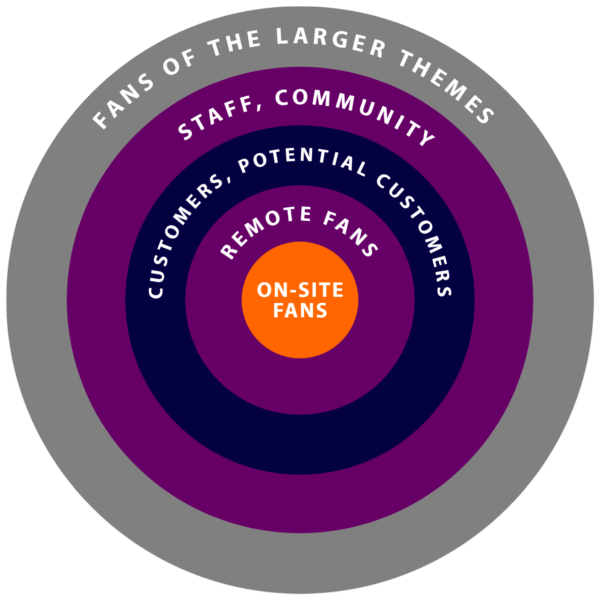
Instead, think about the larger themes of what you’re sponsoring – and there will be plenty of larger themes – and whether they have meaning to your target markets. Sporty types don’t have to be fans of a specific team to be interested in elite injury management strategies from their team physios. Investors don’t have to attend Davos to be interested in an exclusive investor Q&A with one of the big name speakers. Art buffs don’t have to live anywhere near a major art gallery to be interested in exclusive content around a promotion winner shadowing the curator for three days.
Thinking this way extends the impacted markets, geographic footprint, and timeframe of what you’re sponsoring. It also expands your leverage program so that a significant amount of it is happening outside of the often very cluttered space around the property itself.
I’m not saying that the fans of what you’re sponsoring aren’t important, because they certainly are, but that your broader markets hold a ton of potential for your brand, if you leverage it to them in a way that’s meaningful.
I actually hate this question. Unfortunately, it’s common.
The first thing to know is that it’s leverage – not the sponsorship itself – that drives results. If your company can’t commit to leveraging a sponsorship properly, don’t do it. You’ll just be wasting money on an unrealised opportunity.
The other thing is that leverage doesn’t have to cost a huge amount of money. Some of the best sponsors in the world are spending 10-35% of their rights fees, incrementally, on leveraging most sponsorships. This contrasts with the common (but ridiculous) recommendation that sponsors should spend 100-200% of the rights fee or more on leverage.
The key to making this work is to leverage across already budgeted channels first, using the sponsorship to add meaning and relevance to existing activities. Then, allocate your incremental leverage budget for big ideas that require some investment. The result will be thorough, strategic, and relatively low cost.
I’ve developed a straightforward process for developing this kind of leverage plan. You can find it, step-by-step, in either of these:
This question is a natural extension to the previous one, and the answer is simple: Get the right stakeholders involved from the start. Get them involved in the leverage planning process. Let them see the interesting angles they can use to advance their objectives. And get their real buy-in for using sponsorships in ways that will resonate with their audiences.
Your social team understands that audience. Your enterprise sales team knows what will impact their major customers. HR knows what kinds of things will land with staff. The list goes on.
And if you’re integrating sponsorships across your channels on a regular basis, sponsorship-driven content will be seamless, and won’t (as we say in Australia) stick out like dogs’ balls.
Going back to the question about achieving brand and business objectives, the first thing you need to do is accept that this multifaceted marketing medium requires multifaceted measurement. This means setting objective targets, benchmarks, and measures right from the start. This is a good blog with the basics of sponsorship measurement.
When it comes to attributing sales to sponsorship, it is tricky, and there’s no way to capture 100% of those sales 100% accurately, just like you can’t attribute sales 100% accurately to one ad campaign. There are, however some strategies that can help. Here are just a few.
This list could go on and on, and your best resource for determining sales measurement options is your sales team, because they do it all the time.
This is not good. You want your sponsorships to be both effective and efficient, with as little waste as possible. Some strategies:
Work with your stakeholder team to leverage every sponsorship before you negotiate. That way, you can negotiate the exact benefits that all of your stakeholders need, and reject the rest. For instance, if you don’t need 200 tickets to every game, that shouldn’t be in the contract. If you don’t need a massive complement of signage, reduce it significantly. On the other hand, if your sales team could use four what-money-can’t-buy experiences for VIP hospitality, or HR would love to get a show preview for staff, negotiate for that. Get creative and thorough about what you need, and super-realistic about what you don’t.
If you’ve got unused benefits – particularly tickets or hospitality – for a current contract, another option is to give them as a block to VIP customers, so one of your VIP customers can entertain their customers or staff. I’ve worked with sponsors to do this on many occasions.
Even better, get your leverage plans in order and do a mid-contract renegotiation. You’re not changing the terms or length of a contract, but swapping benefits around so that it works better for you, the rightsholder, and the fans. If you frame it like that, and point out that it will be a lot easier for you to renew if you’re getting a better result, most rightsholders won’t kick up much of a fuss.
This question goes straight back to the question about how to deal with a limited leverage budget. They key is to get them involved early. Literally, involve them in the decision to go ahead and negotiate, what benefits to negotiate for, how they’re going to leverage the sponsorship, and how they’ll measure it. If they’re involved, they’ll use the sponsorship. If the think the sponsorship is being inflicted upon them, without getting any input, they won’t.
This is a great question, and one I work on a lot.
Consistency is an issue with almost every sponsorship portfolio, whether it’s between national and local sponsorships, national and regional teams, or even different brand teams in the same building! This can be complex, but these are a few of the strategies I use.
I regularly deliver these best practice, consistency-building projects. If you want to find out more about them, see my Sponsorship Systems Design™ page.
Easy. Leverage them properly.
Don’t put charities and community programs in some other category, because there is no other category. Sponsorship is sponsorship, and it only works when leveraged. I’ve got an entire blog about this, which I suggest you check out Should Your Community Sponsorships Be Managed Separately from Other Sponsorships? (Short answer: No.)
At the risk of harping on about it, you need to involve your stakeholders in renewal decisions and ask some hard questions:
There are certainly other questions, but these would be some of the most important.
Here are a few good resources that expand on all of my answers above.
If you’re interested in working with me, I can provide the following options. Just click through for more information, and drop me a line if you want to discuss.
© Kim Skildum-Reid. All rights reserved. To enquire about republishing or distribution, please see the blog and white paper reprints page.